Tuesday, April 9, 2013

Identity theft

Stop Thief!

   Identity theft is when someone steals your personal information and uses it without your permission. It is hard to stop a thief when you can't see them stealing your things. Identity theft has become more prevalent with the increasing amount of online activity out there. Most of us have the internet on our Smart phones as well as computers, laptops and tablets. Identity theft can damage your finances, credit history and your reputation. And it can cost quite a bit of money to undue the damage. 
   How can you stop it? You can't all the time, but you can learn to protect yourself. 
* Never give out your Social Security number in these 5 Places.
* Be on the alert for Scams. The FTC will post consumer scams as they become known. 
* Take precautions to guard your Smart Phone risks.

  Find out if you can add Identity Theft protection to your Homeowners insurance policy.  It will help pay for the aftermath of identity theft. It will help cover court costs, certified mailings to law enforcement, financial institutions and credit agencies. It will also cover lost wages while you attend court and the associated attorney fees. It is usually inexpensive ($40-$75) a year to add this coverage. Call your insurance agent and make sure you have this protection on your policy!

Tuesday, March 26, 2013

How to find an Insurance agency

Choose Your Company Well!

   There are so many choices when it comes to Insurance these days. There are several carriers, different types of agencies, not to mention, the number of different types of policies. 
I am going to concentrate on what to look at when choosing an agency today. 
The are 3 types of agencies out there: 
* Captive agencies only write for one carrier.
* Independent agencies write for several carriers.
* Direct agencies just have a phone number to call, no actual agent required.
How do you choose? 
First of all, ask your friends and family. Referrals are a great way to find services to meet your need. But make sure you make the decision based on what you are looking for. Your sister may love her insurance company, but it may not fit your needs.
You can also go to the TDI (Texas Department of Insurance) and research any insurance company in the state. You can find types of insurance the company writes, if it uses credit to determine premium, it's financial stability rating and the complaints against the company, among other information.  
   Why is all of this important?
* If they write several types of insurance, you could get bundle discounts for putting your home, auto, life, commercial insurance into one carrier.
* If the company uses credit to place you into a premium tiering, the pricing is greatly affected by your payment and insurance history. (good or bad...)
* The financial stability of a company will let you know how well they are able to take care of customers- If a company has an A rating, it is more likely to be able to pay out claims and keep pricing stable.
* If there are a high number of complaints against a company, you may want to check further into its Customer Service and Claims handling processes.
    Once you make sure the agency/company you are thinking about is a solid choice, make phone calls. Insurance is a big purchase. It should take care of you in bad times, when you need it most. That is what it is designed for.  Not all agents/agencies/carriers are built the same with the same motivation. Go with your gut. If you get a feeling someone isn't looking out for your bets interests, move on. If they are not explaining coverage to you so that you know what you are buying, move on. You should trust your agent/carrier to take care of you. That is what we are here for!
 Contact the Brockman Agency toll free 1-877-987-8683

Wednesday, March 20, 2013

Accident scams

Have You Been Scammed?

Believe it or not, there are con men out to wreck your car! They literally have choreographed auto accident scams they practice and use to take your money. There are several types of these scams to avoid:

The T-Bone  
The scam artist will wait for your car to go through an intersection and then accelerated and "t-bone" your car. When the police arrive, phony witnesses will swear you were the one who ran the stop sign or red light, putting you at fault. 
The Wave  This is used in heavy traffic. When you are trying to switch lanes, the scam artist will wave you over, then gun the gas and hit your car. When the police show up, they will deny waving you over and explain that you just whipped over and hit them, putting you at fault. 
Swoop and Stop  A car will suddenly pull in front of you and stop. Another car will pull up along side of you at the same time, keeping you from being able to swerve. False witnesses will file personal injury claims, using a shady dr. or chiropractor. Others may go to a real doctor and claim whiplash or another type of "soft tissue" injury that is very hard to prove/disprove.
False Endorsement
Following an accident, a scam artist will provide contact numbers to an alleged five- star repair shop, a powerful lawyer or a caring doctor. Each, in league with the scammer, will overcharge you for the services you may or may not have needed in the first place.

Protect Yourself! 
The more information you provide/require, the less able the scam artist to take advantage. Always take pictures of the accident (your phone should work fine for this). Take a picture of the license plate and ever angle of the damage on both cars. Keep pen and paper in your car. Get the following information from all drivers involved:
* Driver's license number
* Vehicle registration info
*. Car Insurance
* Name, address and phone number
Always call the police, especially if you suspect anything fishy. And be careful what personal information you disclose. Identity theft is another scam you want to avoid!

Friday, March 15, 2013

Travel Insurance

The Best Laid Plans...


   You have planned that vacation for months. The Plane, Hotel, Car rental are all booked and paid for. But what happens when your vacation is side swiped? Most arrangements are "Nonrefundable" these days. How do you get your money back for a vacation you paid for, but never got to take?
   Travel Insurance may be that answer! You can get different types of coverage, depending on your possible needs. 

Trip cancellation and interruption insurance 
This can be used in case of weather, natural disaster, strike, illness, traffic accident, and job reasons. 

Medical and Evacuation Insurance
This can be used for accident, sickness, evacuation, and pre-existing medical conditions, with hospital admission assistance.

Baggage Delay, Theft and Loss Insurance
This can used for baggage delay, loss and theft, with assistance for ID protection, cash advance, and prescription replacement.

Don't let a trip up in your vacation cost you more than it has to!


Tuesday, March 12, 2013

Claims

Think Before You Claim!

   That storm last night took some tiles off of your roof. It also blew down tree branches onto your fence. Do you file a claim? There is no hard and fast rule about filing insurance claims. The sole purpose of insurance is to make you whole again in the event of a loss. But what if it is a minor loss? Is it worth the possible rate increase?
   One rule of thumb we have used with customers is to use your deductible to judge. If you have a 1% deductible on a $250,000 dwelling value, your out of pocket will be $2,500. If the damage is less than the $2,500, it may be a good idea to pay for the repairs out of pocket and not file the claim. If it is more than the deductible, you most likely would want to file the claim to keep your out of pocket expenses in check. But you may see a premium increase at your next renewal. 
   Weather Claims and Catastrophe claims do not usually cause an increase in your premium. Slips and falls, water and Dog Bites are the most common claims that will cause an increase in your premium. Many carriers will not insure a homeowner with multiple water claims. And those that will insure with multiple water claims, will do so at a higher premium. 
   Carriers will offer various deductibles. The higher the deductible, the lower the premium and vice versa. With a homeowners policy you will generally have 2 different deductibles. One for Wind/Hail and one for All other perils.
You can often get the same amount for both deductibles, or choose different amounts for each. Again, the pricing will vary so ask talk with your agent before you sign off on the policy. Know what you have. 
  You pay for insurance so it will compensate you in the case of a loss. There is a fine line between not needing to file a claim and needing to file a claim.  If you do have a claim, talk with your agent to help you decide what the next step will be.  That is what your insurance agent is there for! If you need an agent, contact us at The Brockman Agency

Thanks for reading!

Monday, March 11, 2013

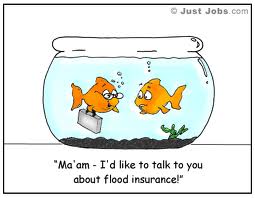
Flood Insurance

Don't Get Caught Under Water!

  Most people believe you are safe from flooding if you don't live on the coast. The truth is if you live where it rains, you are subject to the possibility of flooding. Certain areas are more prone to serious flooding than others. But keep in mind, flooding can happen anywhere. 
    Fast melting snow, severe storms and heavy rainfall can cause flooding far inland. People living outside of the high risk flood areas file more than 20% of the claims in the National Flood Insurance program. Those same claims receive 1/3 of the disaster assistance for flooding. As little as 1 inch of water can cause damage to your home. Damage your Home insurance policy will not cover. A car can be carried away by as little as 2 feet of flood water. These are just a few good to know  Flood Facts.
   The average residential flood claim is around $30,000. This doesn't include the claims from Catastrophes.  A flood policy will cover the building and the contents. Personal property coverage is optional, so be sure to discuss what you want with your agent.  Premiums can start as low as $150 annually, depending on the amount of coverage and the risk factors of the area. If you are in a high risk zone, your mortgage company will require a flood policy. If you are in a moderate-low risk area, a flood policy is optional.High risk areas will have higher premiums than the moderate-low risk areas.
   You can obtain a policy through the federal government under FEMA's National Flood Insurance Program, or you can go through private insurers. Private insurance may offer different limits of coverage and premium.  There are various levels of coverage and deductibles. You will have a separate deductible for both the building and the contents.  Talk with your insurance agent to decide what would be best for you. There is typically a 30 day wait period for any flood policy to take affect. Keep this mind when your mortgage company requires a flood policy on your new home. You will need to file for the policy at least 30 days before your closing date. 
 
Thanks for reading!
Nancy Brockman

As always, please contact The Brockman Agency with any questions on your Home, Auto, Business or Life Insurance.
We partner with 20 carriers, so we do the shopping for you! 


Thursday, March 7, 2013

Personal Umbrella Policy

When it Rains, it Pours-   Are You Covered?

   There was a time when only the rich and powerful needed a Personal Umbrella Policy (PUP). Not any more. If you own a home and/or a boat, you should look at what a PUP can offer you. If you own a dog, trampoline or pool, your liability risk increases exponentially and I strongly urge you to consider an Umbrella Policy.  If you own your own business, you should look at what a commercial umbrella policy can offer you.
  Why? What can an Umbrella Policy do for you? Think of it as an added layer of protection for your assets and more importantly, for your family.  It is Liability coverage above and beyond the limits on your Homeowner's, Watercraft and Auto policies.  You have liability coverage on your Homeowner's, watercraft and Auto policies. But they have limits. Unfortunately, anyone can sue anyone these days. And attorneys  are asking for more and more in  "damages".   Your liability limits cover medical bills, rehabilitation, lost wages. Add in any damages that you may have to pay to the injured party, and your current policy limits may well be below what is needed. Then what do you do? Your assets can be siezed and sold to pay the awarded damages. And you are left with no recourse and possibly more debt than you can ever repay.
   Simply put, a Personal Umbrella Policy will offer coverage when your home, watercraft and/or auto policy limits run out. A PUP is often inexpensive, as low as $150 annually for $1million in cover. When you compare it to the added coverage and what you could lose without the coverage, isn't it worth it? 


Thanks for reading!
Nancy Brockman

Please contact  The Brockman Agency for quotes and answers to your questions about Home, Auto and Commercial insurance. We partner with 20 carriers, so we can do the shopping for you!